
TL;DR
No published human trial has tested an oral monolaurin dose. The human studies that exist applied monolaurin to surfaces: vaginal gels, a tampon coating, a mouthwash. Oral dosing research is limited to animals. The amounts printed on supplement labels come from convention and manufacturing practice, not from dose-finding trials.
Key Takeaways
- Every human trial of monolaurin indexed in PubMed is topical or intravaginal, which means no clinical study has established an oral monolaurin dose for people.
- Laboratory studies of monolaurin report concentrations in micrograms per millilitre, a measure of how much sits in a dish of fluid, which cannot be converted into milligrams in a capsule.
- Oral monolaurin research does exist in animals, at 1,000 mg per kilogram of feed in weaned piglets and 500 mg per kilogram of body weight in mice, and neither figure transfers to a human serving.
- Monolaurin is a monoglyceride of lauric acid, a class the FDA lists among direct food substances affirmed as generally recognized as safe, so its regulatory footing is that of a food ingredient rather than a medicine with an approved dose.
- Because no dose-response curve exists, the practical questions worth asking are about formulation, consistency and product quality rather than about finding an optimal number.
Search for monolaurin dosage and the results arrive with striking confidence. Charts of starting amounts. Maintenance ranges. Schedules for building up week by week.
Then you look for the study behind the numbers, and it is difficult to find. That gap is worth understanding, because it changes which questions are useful.
What follows is what the published research actually contains: which studies were run in humans, what form monolaurin took in them, what the animal work measured, and why none of it adds up to a dose you can look up.
What Has Monolaurin Been Tested On in Humans?
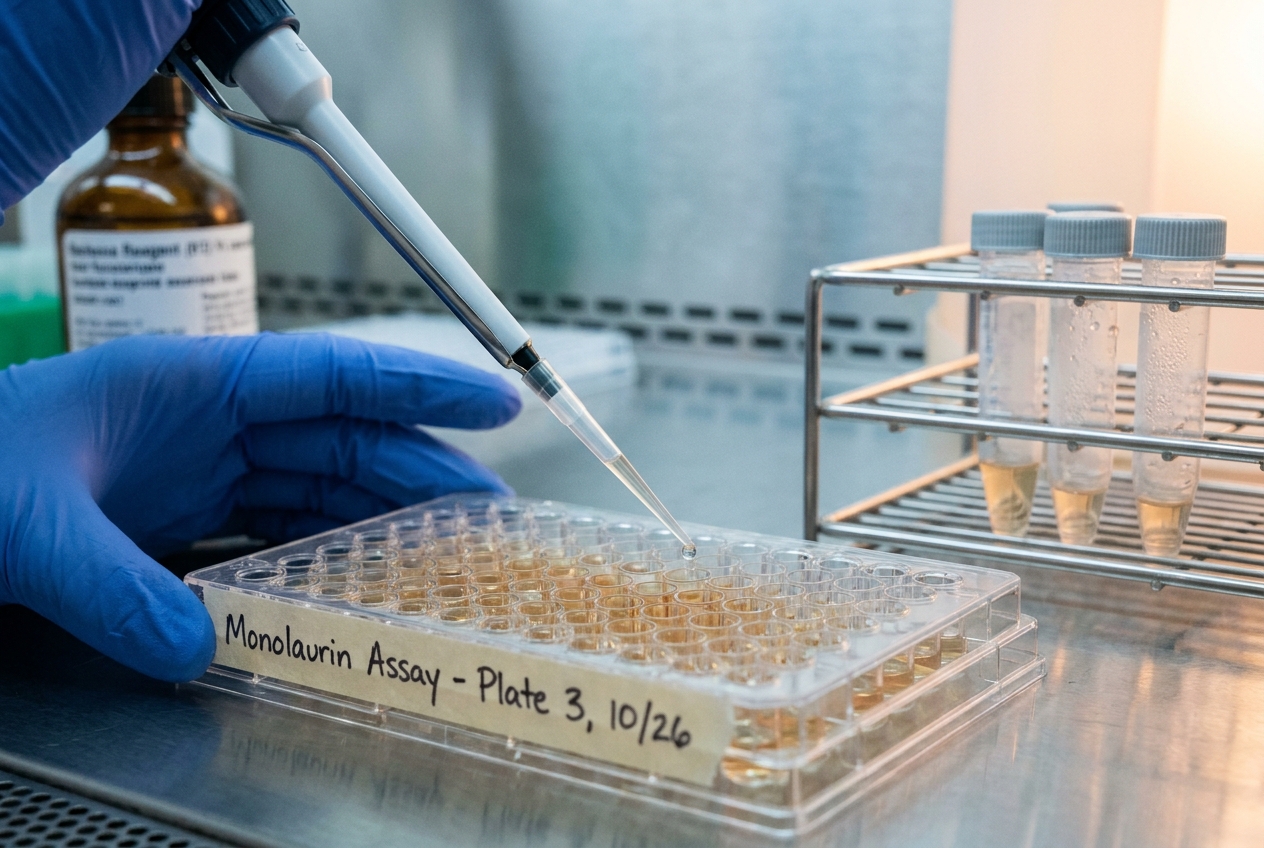
Four human studies of monolaurin appear in PubMed, and all four applied it to a surface of the body rather than swallowing it.
The largest was a multicenter, double-blind randomized trial published in the Journal of Lower Genital Tract Disease, which gave 109 women a 5% monolaurin vaginal gel or a placebo gel twice daily for three days. On the trial’s primary endpoint, resolution of all four Amsel criteria for bacterial vaginosis, the monolaurin gel performed no better than placebo: 17% against 25%. The researchers did note an increase in Lactobacillus counts in the monolaurin group, and suggested that as a direction for future work.
An earlier randomized double-blind study in Antimicrobial Agents and Chemotherapy gave 36 women intravaginal gels containing 0%, 0.5% or 5% glycerol monolaurate (GML), the chemical name for monolaurin, every 12 hours for two days. The gels reduced Candida and Gardnerella vaginalis counts while leaving Lactobacillus counts and vaginal pH unchanged, and no adverse events were reported.
A third study, in Clinical Infectious Diseases, took a different route entirely: it used GML as a fiber finish on tampons worn by 225 women, and found lower levels of Staphylococcus aureus exotoxins and the inflammatory marker interleukin 8 in the GML tampons. A fourth used a mouthwash containing 0.2% GML alongside 0.4% lysine, looking at Helicobacter pylori in the mouth.
Notice what is missing. Not one of these studies involved a capsule, a powder or a pellet. Every result describes monolaurin acting where it was placed, at a known percentage, on a specific surface.
Why Don’t Laboratory Numbers Translate Into a Capsule Dose?
The in vitro work on monolaurin does report numbers, and they look precise. In the Antimicrobial Agents and Chemotherapy study, a GML concentration of 500 micrograms per millilitre was candicidal for every Candida species tested, and 10 micrograms per millilitre was bactericidal for Gardnerella vaginalis.
Those are concentrations, and that is a different kind of quantity from a dose. A concentration describes how much compound surrounds a cell in a controlled volume of fluid. A dose describes how much you swallow, before digestion, absorption, distribution and metabolism have their turn. Converting one into the other requires knowing what fraction of a swallowed amount reaches a given tissue and at what concentration it arrives, and for oral monolaurin in humans, that work has not been published.
Two properties make the gap harder to close. Monolaurin is highly lipophilic with very low water solubility, a point our breakdown of monolaurin’s scientific limitations examines in more detail. It is also a monoglyceride, the same class of molecule your digestive system produces when it breaks down dietary fat, which means the gut treats it as food rather than as a foreign compound to be delivered intact.
Animal research has tested oral routes, and the way those doses are expressed shows the problem clearly. A study in the Journal of Animal Science fed 96 weaned piglets a diet containing 1,000 mg of α-GML per kilogram of feed for 28 days. Growth rate was unchanged, diarrhea rate fell in the second half of the trial, and nutrient digestibility and intestinal villus height improved. That is a concentration in animal feed, in pigs, measured on outcomes specific to weaning.
A separate study in Frontiers in Nutrition gave mice oral GML at 500 mg per kilogram of body weight for two weeks in a chemically induced model of colitis, reporting reduced inflammatory signalling and shifts in gut bacteria. Scaled naively, 500 mg per kilogram would mean tens of grams a day for an adult human, which no supplement label suggests and no human study has evaluated. Species differ in metabolism, and induced disease models differ from healthy physiology, so these figures describe what happened in those animals rather than what should happen in a person.
What Factors Actually Matter When Using Monolaurin?
With no dose-response curve to optimize against, the useful variables are different from the ones people usually search for.
- Formulation over milligrams. Because solubility limits how much monolaurin dissolves, how a product is made matters. Our guide to choosing a monolaurin supplement walks through pellets, capsules and the excipients that affect dispersion.
- Consistency over intensity. No published trial supports the idea that a larger single amount produces a proportionally larger effect in humans. Regular use as part of a routine is a more defensible pattern than chasing a number.
- Food context. Monolaurin behaves like a dietary lipid, so taking it with a meal containing fat is a mechanistically sensible habit. Treat it as reasoning from chemistry, not as a finding from a human trial, because that trial has not been run.
- Your own tolerance. Digestive comfort varies between people and between formats. Starting modestly and paying attention to how you feel is the practical substitute for a validated schedule.
- Product quality. Third-party testing, transparent labelling and a manufacturer willing to state exactly what is in each serving matter more when the science leaves the amount open. The monolaurin range at Shop Monolaurin is one place to compare those criteria.
- Your clinician. Anyone taking medication, pregnant, breastfeeding or managing a health condition should raise a new supplement with a healthcare professional, which is a more useful safeguard than any dosing chart online.

Frequently Asked Questions
Is there a clinically proven monolaurin dosage?
No. As of this writing, PubMed indexes no human trial that tested an oral monolaurin dose and measured the result. The human studies available used topical or intravaginal formulations at stated percentages, such as a 5% vaginal gel, which describe a concentration in a product rather than an amount to swallow.
Where do the milligram amounts on monolaurin labels come from?
They come from manufacturing practice, capsule sizing and practitioner convention rather than from published dose-finding research. That does not make them arbitrary or unsafe, but it does mean a label number carries a different kind of authority than a dose established in a clinical trial.
Should monolaurin be taken with or without food?
Monolaurin is a monoglyceride, the same family of molecules the body produces while digesting fat, so taking it alongside a meal containing fat fits how the compound is handled. No human study has compared the two conditions directly, so treat this as a mechanistic rationale rather than a proven instruction.
Is monolaurin safe?
Monoglycerides of lauric acid belong to a class the FDA lists among direct food substances affirmed as generally recognized as safe for use in food. In the intravaginal trials described above, no adverse events were reported. Long-term oral safety at supplement amounts in humans has not been formally studied, which is a gap rather than a warning sign.
Does taking more monolaurin work better?
There is no published human evidence for a dose-response relationship, so “more is better” is an assumption rather than a finding. The animal work used fixed amounts and did not compare escalating ones, and the human work varied concentration in a gel rather than an amount in a capsule.
What would it take to establish a real monolaurin dose?
A dose-ranging trial in people: several oral amounts, a placebo group, measurement of what actually reaches the bloodstream, and a defined outcome. Until a study like that is published and replicated, the honest answer to the dosage question stays open, and the wider questions readers ask about monolaurin are a better use of attention.

The Bottom Line
Monolaurin has a genuine and interesting research base. Laboratory work shows it disrupting lipid membranes at measurable concentrations, four human studies show it doing something useful on the surfaces where it was applied, and animal work suggests effects on the gut worth following. What that research does not contain is an oral dose tested in people.
That is a reasonable thing to say out loud. A supplement can be worth taking while its optimal amount remains unestablished, and knowing which parts of the story are evidence and which are convention is what lets you evaluate a product honestly. Formulation, consistency, tolerance and manufacturer transparency are the levers actually available. The perfect number is not one of them yet.
Continue Exploring
- Does Monolaurin Always Work? Understanding Its Scientific Limitations
- How to Choose the Best Monolaurin Supplement for Beginners
- What Are the Most Frequently Asked Questions About Monolaurin?
References
- Mancuso AC, Widdice LE, Hughes BL, et al. Five Percent Monolaurin Vaginal Gel for the Treatment of Bacterial Vaginosis: A Randomized Placebo-Controlled Trial. Journal of Lower Genital Tract Disease, 2020. https://doi.org/10.1097/LGT.0000000000000543
- Strandberg KL, Peterson ML, Lin YC, et al. Glycerol monolaurate inhibits Candida and Gardnerella vaginalis in vitro and in vivo but not Lactobacillus. Antimicrobial Agents and Chemotherapy, 2010. https://doi.org/10.1128/AAC.01151-09
- Strandberg KL, Peterson ML, Schaefers MM, et al. Reduction in Staphylococcus aureus growth and exotoxin production and in vaginal interleukin 8 levels due to glycerol monolaurate in tampons. Clinical Infectious Diseases, 2009. https://doi.org/10.1086/644614
- Wang XM, Yee KC, Hazeki-Taylor N, et al. Oral Helicobacter pylori, its relationship to successful eradication of gastric H. pylori and saliva culture confirmation. Journal of Physiology and Pharmacology, 2014. PMID 25179088. https://pubmed.ncbi.nlm.nih.gov/25179088/
- Li L, Wang H, Zhang N, et al. Effects of α-glycerol monolaurate on intestinal morphology, nutrient digestibility, serum profiles, and gut microbiota in weaned piglets. Journal of Animal Science, 2022. https://doi.org/10.1093/jas/skac046
- He KJ, Dong JH, Ouyang XM, et al. Glycerol monolaurate ameliorates DSS-induced acute colitis by inhibiting infiltration of Th17, neutrophils, macrophages and altering the gut microbiota. Frontiers in Nutrition, 2022. https://doi.org/10.3389/fnut.2022.911315
- U.S. Food and Drug Administration. 21 CFR 184.1505, Mono- and diglycerides, Direct Food Substances Affirmed as Generally Recognized as Safe. https://www.ecfr.gov/current/title-21/chapter-I/subchapter-B/part-184/subpart-B/section-184.1505
This content is for educational and informational purposes only and does not constitute medical advice. Please consult with a healthcare professional before starting any new supplement, dietary changes, or wellness routine.