
TL;DR
Monolaurin may support the body’s defenses against enveloped viruses, the group that includes influenza, SARS-CoV-2 and RSV, because lab studies show it disrupts the viral lipid envelope. For the 2026-27 season, no human trial shows monolaurin prevents colds or flu. It may complement, not replace, the updated vaccine and everyday hygiene.
Key Takeaways
- The CDC expects the 2026-27 respiratory season to bring a combined peak of hospitalizations within 20% of last season’s, with influenza at moderate severity.
- Monolaurin may be relevant this season because influenza, SARS-CoV-2 and RSV all wear a fatty envelope, and test-tube studies show monolaurin breaks that envelope down.
- Monolaurin has no published human trial showing it prevents colds or flu, and the closest human data is an observational COVID-19 cohort that shows association, not cause.
- Monolaurin did not inhibit rhinoviruses in cell culture, so it should not be expected to cover every cause of the common cold.
- Monolaurin is best viewed as an optional add-on to the CDC’s core steps, including the 2026-27 flu vaccine that was updated for H3N2 subclade K.
What Makes Cold and Flu Season 2026-27 Different?
Cold and flu season 2026-27 is arriving after a year that left its mark. The 2025-26 season was rated moderate in severity overall, but high in severity for children, according to the CDC. A mutated influenza A(H3N2) strain called subclade K spread widely, and RSV hospitalizations peaked late, on February 21, 2026. Many people now want to know whether a supplement like monolaurin, a compound made from the lauric acid in coconut oil, has a place in this year’s routine.
The honest answer starts with what the research does and does not show. Monolaurin has a clear, well-documented effect on certain viruses in the laboratory. What it has not been shown to do, in published human trials, is prevent a cold or the flu.
What Does the CDC Expect This Season?
The CDC’s 2026-2027 Respiratory Disease Season Outlook, published September 23, 2026, expects a similar combined number of peak hospitalizations from COVID-19, influenza and RSV compared with last season, within 20%, with low to moderate confidence. Influenza is anticipated to be moderate in severity across all ages.
COVID-19 is the most uncertain piece. The outlook projects a peak in early to mid January at 1.4 to 2.5 hospitalizations per 100,000 people if no new variant emerges, rising to 2.8 to 6.7 per 100,000 if a variant with moderate immune escape appears. About 65% of surveyed experts judged such a variant unlikely. RSV is expected to peak within 20% of last season’s rate.
The flu vaccine changed too. According to the CDC’s 2026-2027 flu season page, all three components of the vaccine were updated, including an A/Darwin H3N2 strain chosen to address subclade K. Manufacturers project up to 135 million doses for the U.S. market.
Why Does Cold and Flu Season Follow the Calendar?
Weather explains part of the pattern. A 2026 study in PNAS Nexus found that a combined, nonlinear effect of specific humidity and temperature explains influenza outbreak seasonality across both temperate and tropical climates. Cold, dry air appears to favor spread.
Weather is not the whole story. A 2026 analysis of influenza-like illness in Taiwan, published in PLoS One, found that humidity had the strongest link to incidence (r = -0.147), yet temperature, humidity, pressure and rainfall together explained only 4.5% of the variance. Time indoors, close contact and shared air account for much of the rest.
The CDC describes the mechanism plainly. Flu viruses spread mainly through droplets made when people cough, sneeze or talk, and a healthy adult may be able to infect others beginning one day before symptoms appear and for five to seven days after becoming ill. That silent window is why avoiding visibly sick people alone does not stop a season.
How Does Monolaurin Work Against Viruses?
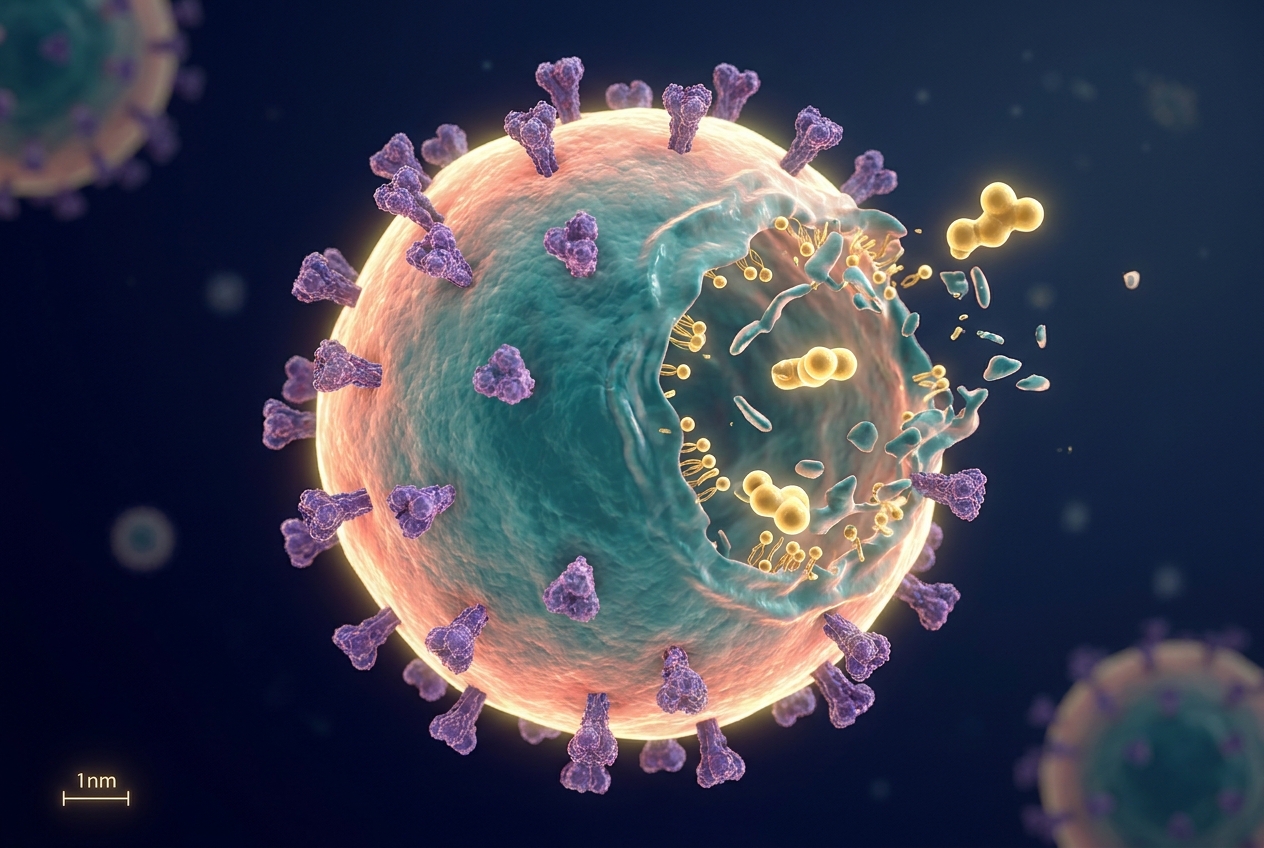
Monolaurin is the monoglyceride form of lauric acid, also called glycerol monolaurate (GML). Its relevance to respiratory season comes from one structural feature of certain viruses: the lipid envelope, a fatty membrane some viruses wear around their genetic material.
A 1994 paper in the Annals of the New York Academy of Sciences reported that medium-chain fatty acids and monoglycerides inactivated visna virus and other enveloped viruses, with monoglycerides proving more antiviral than the matching free fatty acids. The compounds caused leakage in the envelope and, at higher concentrations, its complete disintegration. A simple analogy is dish soap on a greasy pan: the fat-soluble molecule inserts itself into the membrane and breaks it apart. The site’s explainer on monolaurin’s antiviral mechanism walks through this idea in more detail.
An older but widely cited study, Hierholzer and Kabara (1982), tested monolaurin against 14 human enveloped RNA and DNA viruses in cell culture. At a 1% concentration for one hour at 23 °C, every virus lost more than 99.9% of its infectivity, and the authors attributed the effect to disintegration of the viral envelope.
Influenza viruses, SARS-CoV-2 and RSV are all enveloped, which makes this the main scientific reason monolaurin comes up every respiratory season. It is also where the caution begins: these were in vitro experiments with direct contact between compound and virus, at concentrations a capsule does not necessarily reproduce inside the body.
What Does Newer Research Say About Influenza and COVID-19?
A 2025 study in Pharmaceutics tested oral and nasal formulations containing monolaurin (0.1 to 0.2%), D-limonene and cetylpyridinium chloride against SARS-CoV-2 and influenza viruses in vitro. The formulations achieved more than 99.99% efficacy against several influenza strains. Because three active ingredients were combined, the result cannot be credited to monolaurin alone, and it was not a human study.
The most relevant human data comes from Italy. A 2025 prospective cohort study in the International Journal of Molecular Sciences followed healthcare workers for six months and found that higher serum monolaurin levels were associated with a lower risk of COVID-19 at three and six months. This observational design is the key limit: it shows that people with higher blood monolaurin got infected less often, not that taking monolaurin caused the difference, and the study did not test a supplement or cover influenza.
A 2020 study in mSphere tested monolaurin directly in people. Forty healthy volunteers swabbed their nostrils with a 5% glycerol monolaurate gel for three days, and the gel produced a 3-log reduction in Staphylococcus aureus and coagulase-negative staphylococci. That was a bacteria study using a topical gel, but the authors noted that the gel kills enveloped viruses in testing and suggested it deserves study for coronavirus and influenza transmission.
There is also an immune-system angle. A 2022 PLoS One study in cattle found that an inactivated bovine virus diarrhea vaccine adjuvanted with 1% or 2% monolaurin produced higher and longer-lasting neutralizing antibodies than a conventional aluminum hydroxide vaccine. That animal finding suggests immunomodulatory properties, but it does not show the same effect in people taking a daily supplement.
The site’s earlier articles on flu season and monolaurin and on monolaurin as a flu season defense cover the broader influenza literature.
What Are the Limits of Monolaurin for Colds?
The word “cold” covers many viruses, and monolaurin’s mechanism does not reach all of them. Rhinoviruses, a frequent cause of the common cold, have a protein shell rather than a lipid envelope. A 2000 study in the Journal of Medical Microbiology tested monolaurin, vitamin A, lactoferrin and other human-milk factors against three rhinoviruses in cell culture, and none of the compounds inhibited rhinovirus growth.
So the mechanism fits influenza, SARS-CoV-2 and RSV on paper, but not every cold. The site’s discussion of monolaurin’s scientific limitations covers other gaps, including low water solubility and viruses without envelopes.
What Should You Do to Prepare for Cold and Flu Season 2026-27?
The CDC’s core prevention steps for respiratory viruses are four: stay up to date on recommended immunizations, practice good hygiene such as regular handwashing and cleaning commonly touched surfaces, take steps toward cleaner air where people live and work, and stay home and away from others when sick. This year the immunization step includes a flu vaccine reformulated for subclade K. These steps have the strongest evidence behind them and sit at the center of any plan.
Monolaurin, if used at all, belongs at the edge of that plan as an educational, supplementary consideration. It is wise to speak with a healthcare provider first, especially for anyone who is pregnant, immunocompromised, taking medication or managing a chronic condition.
How Should You Evaluate a Monolaurin Supplement?
Quality varies widely, so a neutral checklist helps:
- Ingredient form: monolaurin (glycerol monolaurate) is a different compound from lauric acid or coconut oil, and the label should say which one it contains.
- Amount per serving: the milligrams of monolaurin should be stated plainly, not hidden in a proprietary blend.
- Third-party testing: a certificate of analysis for purity and contaminants signals manufacturing accountability.
- Simple formulation: a short ingredient list with no unnecessary fillers or undisclosed additives.
Readers who want to compare options can start at shopmonolaurin.com.
Frequently Asked Questions
Does monolaurin prevent colds and flu?
No published human trial has shown that monolaurin prevents colds or flu. Laboratory studies show it disrupts the lipid envelope of influenza and other enveloped viruses, but test-tube results do not guarantee the same outcome from a daily supplement.
How bad is the 2026-27 cold and flu season expected to be?
The CDC expects a combined peak of COVID-19, influenza and RSV hospitalizations within 20% of last season’s, with influenza at moderate severity. Confidence is low to moderate, and a new COVID-19 variant is the main factor that could raise the peak.
What is influenza subclade K, and is the 2026-27 vaccine matched to it?
Subclade K is a mutated form of influenza A(H3N2) that spread widely in 2025-26. The CDC reports that all three components of the 2026-27 vaccine were updated, including an H3N2 strain chosen to address subclade K.
Is monolaurin effective against rhinoviruses?
Not in the one study found. A 2000 cell-culture experiment found that monolaurin did not inhibit three rhinoviruses. Rhinoviruses lack a lipid envelope, which is the structure monolaurin is thought to disrupt.
Can monolaurin replace the flu shot?
No. The CDC lists staying up to date on immunizations first among its core prevention steps. Monolaurin research is largely in vitro and animal-based, so it is not a stand-in for vaccination.
Summary
Cold and flu season 2026-27 is expected to look much like last year’s, with moderate influenza, a COVID-19 peak in January that depends on whether a new variant appears, and a reformulated flu vaccine aimed at subclade K. Monolaurin enters the picture because its mechanism, disrupting lipid envelopes, matches the structure of influenza, SARS-CoV-2 and RSV.
The evidence stops short of prevention. The strongest findings are in vitro and animal studies, the one human cohort shows an association rather than a cause, and rhinoviruses were unaffected. Vaccination, handwashing, cleaner air and staying home when sick remain the foundation, with monolaurin as an optional, educational add-on to discuss with a healthcare provider.
Continue Exploring
- Flu Season Is Coming: Can Monolaurin Help?
- Is Monolaurin Your Best Defense Against Flu Season?
- Does Monolaurin Always Work? Understanding Its Scientific Limitations
References
- Centers for Disease Control and Prevention. 2026-2027 Respiratory Disease Season Outlook. September 23, 2026. cdc.gov
- Centers for Disease Control and Prevention. 2026-2027 Flu Season. cdc.gov
- Stamper AR, Yang W, Wagner CE, Mahmud AS, Baker RE. Unified climate factors predict influenza outbreak seasonality across tropical and temperate regions. PNAS Nexus, 2026. DOI (PMID 42311476)
- Chen PY, Dang LH, Hung SH. The association between meteorological factors and influenza incidence in Taiwan. PLoS One, 2026. DOI (PMID 42594113)
- Centers for Disease Control and Prevention. About Influenza. cdc.gov
- Thormar H, Isaacs CE, Kim KS, Brown HR. Inactivation of visna virus and other enveloped viruses by free fatty acids and monoglycerides. Annals of the New York Academy of Sciences, 1994. DOI (PMID 8030974)
- Hierholzer JC, Kabara JJ. In vitro effects of monolaurin compounds on enveloped RNA and DNA viruses. Journal of Food Safety, 1982. DOI (PMID 32336838)
- Ponphaiboon J, et al. In vitro development of local antiviral formulations with potent virucidal activity against SARS-CoV-2 and influenza viruses. Pharmaceutics, 2025. DOI (PMID 40143013)
- Sola D, et al. Higher serum monolaurin is associated with a lower risk of COVID-19: results from a prospective observational cohort study. International Journal of Molecular Sciences, 2025. DOI (PMID 40141096)
- Schlievert PM, Peterson ML. Decolonization of human anterior nares of Staphylococcus aureus with use of a glycerol monolaurate nonaqueous gel. mSphere, 2020. DOI (PMID 32727862)
- Abd El Fadeel MR, et al. Efficacy and durability of bovine virus diarrhea (BVD) virus killed vaccine adjuvanted with monolaurin. PLoS One, 2022. DOI (PMID 35834444)
- Clarke NM, May JT. Effect of antimicrobial factors in human milk on rhinoviruses and milk-borne cytomegalovirus in vitro. Journal of Medical Microbiology, 2000. DOI (PMID 10933257)
- Centers for Disease Control and Prevention. Preventing Respiratory Illnesses. cdc.gov