TL;DR
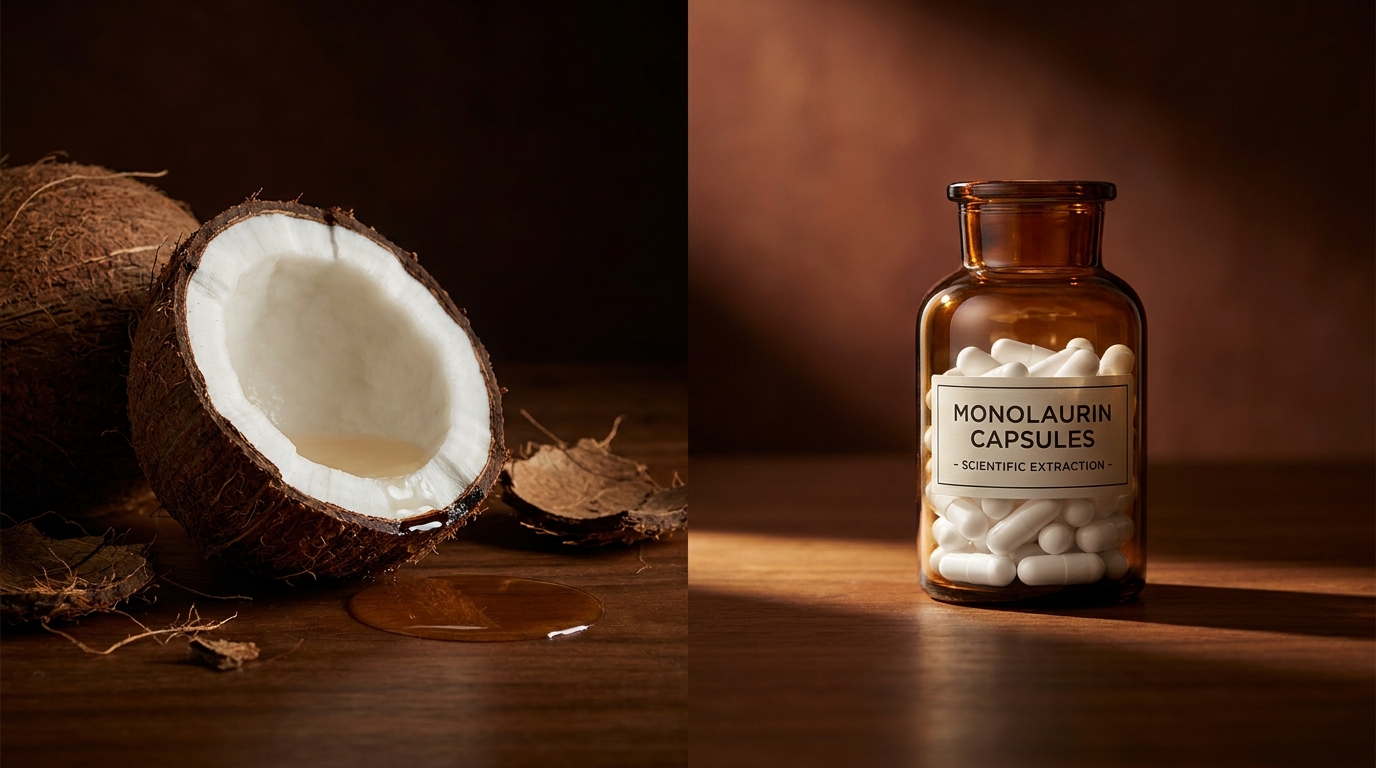
While coconuts and coconut oil are naturally rich in lauric acid, eating them does not provide enough active monolaurin for concentrated immune support. The human body’s enzymatic conversion of dietary lauric acid into monolaurin is highly inefficient. Achieving functional systemic levels would require consuming hundreds of milliliters of coconut oil daily, resulting in severe gastric distress and a massive caloric surplus.
Key Takeaways
- Gastric lipases in the human gut must enzymatically break down the triglycerides in coconut oil to synthesize monolaurin, a process with a notoriously low conversion rate.
- Dietary lauric acid from coconuts is predominantly oxidized by the liver for cellular energy rather than being converted into therapeutic compounds.
- Pre-converted monolaurin supplements offer high serum bioavailability, completely bypassing the biological bottleneck of dietary fat digestion.
- Relying on whole coconuts to match the concentration of a single supplement capsule would require an unrealistic and unhealthy daily volume of saturated fat.
Introduction
Many people exploring natural immune support logically look to coconuts as a primary dietary source. Coconuts are famously abundant in lauric acid, a medium-chain fatty acid celebrated for its unique biological properties. Because lauric acid is the direct chemical precursor to monolaurin, it is easy to assume that eating coconut meat or drinking coconut oil yields the same benefits as taking an isolated supplement.
However, human digestion does not operate on a one-to-one ratio. The presence of a precursor compound in food does not guarantee that the body will manufacture a sufficient volume of the active end-product. The journey from a spoonful of dietary fat to a systemic, immune-modulating molecule is dictated by complex biochemical pathways, rate-limited enzymes, and the body’s constant demand for basic caloric energy. Understanding this digestive math reveals why eating whole foods and targeting specific immune mechanisms require entirely different approaches.

How Does the Body Convert Coconut Oil Into Monolaurin?
To understand the conversion process, we have to look at the structural differences between dietary fats and active lipids. In whole coconuts and coconut oil, lauric acid does not exist as a free-floating, active compound. Instead, it is bound within complex triglycerides—tightly packed fat molecules that the body must carefully dismantle before they can be utilized.
When you consume coconut fat, the digestion process begins in the stomach and continues into the small intestine. According to a 2020 review in the Journal of the Association of Physicians of India, the complex medium-chain fatty acids in coconut oil must be enzymatically broken down by lipases in the gut to release free lauric acid and, eventually, its active monoglyceride derivative, monolaurin. This physiological digestive conversion is absolutely essential to unlock the natural antimicrobial, antiviral, and immune-modulating properties of these lipids.
The synthesis of monolaurin specifically requires the body to cleave the lauric acid away from its original triglyceride structure and meticulously reattach it to a single glycerol backbone. This specific molecular shape—glycerol monolaurate—gives monolaurin its ability to interact with and disrupt the protective lipid envelopes of certain microorganisms. Without this precise enzymatic restructuring, lauric acid remains just a standard dietary fat.
Why Are Coconuts an Inefficient Source of Monolaurin?
The primary limitation of relying on coconut oil for immune support is the profound inefficiency of the human body’s enzymatic conversion process. The digestive system is optimized for extracting energy from fats, not for synthesizing specialized immune compounds.
When you consume coconut oil, the vast majority of the absorbed lauric acid is immediately routed to the liver through the portal vein. There, it undergoes rapid beta-oxidation, meaning the liver burns it for quick cellular energy. Only a fractional percentage escapes this metabolic furnace to be converted into monolaurin by the body’s gastric lipases.
This biological bottleneck makes coconuts an impractical source for targeted support. Because the conversion rate is so limited, achieving a concentrated dose strictly through diet requires an overwhelming volume of fat. Analyzing the natural sources of monolaurin reveals that relying solely on raw coconut oil to achieve a concentrated dose requires an unrealistic consumption of 100 to 300 milliliters of oil daily. Attempting this volume inevitably leads to severe gastric distress, cramping, and an unmanageable caloric surplus. The body simply cannot physically process enough whole coconut fat to synthesize the precise concentrations of monolaurin needed for systemic immune modulation.
Frequently Asked Questions
Does eating raw coconut meat provide monolaurin?
Eating raw coconut meat provides a healthy source of dietary lauric acid, but it does not contain pre-formed monolaurin. Your digestive tract must still break down the meat’s fibrous matrix and extract the triglycerides before the inefficient enzymatic conversion process can even begin, resulting in a minimal monolaurin yield.
How much coconut oil equals one concentrated dose of monolaurin?
Because the human body’s conversion rate of lauric acid to monolaurin is exceptionally low, it is estimated that you would need to consume multiple tablespoons—often upwards of half a cup—of pure coconut oil to yield the exact amount of active monolaurin found in a single high-quality capsule.
Is lauric acid the exact same thing as monolaurin?
No. Lauric acid is a 12-carbon medium-chain fatty acid. Monolaurin (glycerol monolaurate) is a unique derivative created when a single molecule of lauric acid bonds to a glycerol backbone. While lauric acid provides quick metabolic energy, the specific structure of monolaurin allows it to interact directly with microbial lipid envelopes.
What should I look for in a monolaurin supplement?
When evaluating supplements, prioritize pure, isolated monolaurin delivered in a clean capsule format without unnecessary fillers or synthetic excipients. High-quality monolaurin should be clearly dosed to bypass the need for gut-level enzymatic conversion completely.
Bioavailability: Dietary Fats vs. Monolaurin Supplements
The fundamental difference between eating a coconut and taking a dedicated supplement lies in systemic bioavailability. Bioavailability measures how much of an active compound actually enters your bloodstream to circulate throughout the body.
Because dietary lauric acid is constantly fighting to survive oxidation in the liver, its systemic reach as monolaurin is severely restricted. Bypassing this digestive obstacle is the core advantage of supplementation. A 2025 prospective observational cohort study published in the International Journal of Molecular Sciences demonstrated that the direct serum bioavailability of isolated monolaurin (quantified at a protective threshold of >0.45 µg/mL) confers significant systemic immunomodulatory benefits. The researchers noted that pre-formed monolaurin successfully enters the bloodstream at clinical concentrations, entirely bypassing the inefficient, rate-limited gut enzymatic conversion required when consuming raw coconut oil.
This scientific reality makes targeted delivery crucial. For those actively seeking to support their body’s microbial balance and immune response, relying on raw fat digestion is structurally flawed. Choosing to supplement with monolaurin instead of relying on dietary sources ensures that the active compound bypasses the inefficient enzymatic conversion pathway entirely. Pre-converted monolaurin boasts high bioavailability and avoids immediate metabolic oxidation by the liver, ensuring the active compound effectively reaches systemic circulation.
The Verdict: Is Eating Coconuts Enough?
Eating coconuts and consuming coconut oil are excellent ways to introduce healthy, easily digestible medium-chain triglycerides into your diet for sustained energy and general wellness. However, using them as a strategic tool to raise monolaurin levels is biologically ineffective. The human gut’s sluggish conversion rate and the liver’s preference for burning lauric acid as fuel mean that only trace amounts of monolaurin ever materialize from dietary fats.
For individuals looking for concentrated, scientifically validated immune support, bypassing the digestive bottleneck is essential. Opting for pure, pre-formed monolaurin guarantees reliable bioavailability without the metabolic tax of hundreds of liquid calories. You can explore pure, lab-tested formulations designed for optimal systemic absorption at Shop Monolaurin.
Continue Exploring
- What Are the Natural Sources of Monolaurin?
- Monolaurin: Why Supplement with this Natural Antimicrobial?
References
Scientific Literature
- Various Authors. “Coconut Oil and Immunity: What do we really know about it so far?” Journal of the Association of Physicians of India, 2020. https://pubmed.ncbi.nlm.nih.gov/32602684/
- Various Authors. “Higher Serum Monolaurin Is Associated with a Lower Risk of COVID-19: Results from a Prospective Observational Cohort Study.” International Journal of Molecular Sciences, 2025. https://doi.org/10.3390/ijms26062452
Internal Articles